SHOULD ORGANISATIONS DIAGNOSE ORGANISATIONAL HEALTH BEFORE PRESCRIBING WELLNESS PROGRAMMES?
1. Defining the Concepts
1.1. Organisational Wellness
Organisational wellness focuses on the wellbeing of employees within the workplace. It is concerned with mental, emotional, physical, and psychological health, as well as the overall employee experience.
It addresses questions such as:
- Are employees supported?
- Is the workload manageable?
- Do employees feel psychologically safe?
Wellness initiatives often include counselling services, stress management programmes, and employee support interventions.
The World Health Organization (2010) emphasises that promoting employee wellbeing is essential for a healthy workplace and improved productivity.
1.2. Organisational Health
Organisational health refers to the overall effectiveness, sustainability, and ethical functioning of the institution as a system. It includes leadership quality, governance structures, organisational culture, strategy alignment, and accountability mechanisms.
It addresses broader institutional questions:
- Is leadership ethical and trustworthy?
- Are governance and accountability systems functioning?
- Is there alignment between strategy and operations?
- Does the organisational culture support performance and trust?
Lencioni (2012) argues that organisational health is a primary driver of long-term institutional success because it integrates leadership, culture, and systems into a coherent whole.
2. What Organisations Often Do
Many organisations respond to rising stress, burnout, and conflict by introducing wellness programmes. These may include wellness days, resilience workshops, or employee assistance programmes.
While these interventions are valuable, they are often implemented without first examining underlying organisational conditions such as:
- Leadership behaviour
- Governance weaknesses
- Unclear roles and expectations
- Unfair or inconsistent performance management
- Poor communication and low trust environments
As a result, organisations may attempt to support employees while leaving the structural sources of distress unchanged.
3. What Scholars and Research Suggest.
Scholarly research increasingly highlights that employee wellbeing cannot be separated from organisational systems.
Danna and Griffin (1999) found that workplace wellbeing is strongly influenced by organisational structures, leadership practices, and job design.
Cooper and Cartwright (1994) similarly argue that healthy organisations must proactively address organisational stressors rather than focusing only on individual coping mechanisms.
Recent global research also suggests that wellness programmes have limited impact when organisational culture, leadership, and governance systems remain unchanged.
Structural conditions within the organisation significantly shape employee wellbeing outcomes.
This body of evidence suggests that wellness programmes are most effective when implemented within healthy organisational systems.
4. Practical Impact in Organisations
Where organisational health is weak:
- Wellness programmes are often seen as symbolic gestures.
- Employee trust in leadership decreases.
- Burnout continues despite implemented interventions.
- Grievances and conflicts increase.
- Productivity improvements are limited.
- In organisations with strong health, wellness initiatives strengthen an already supportive environment.
- Employees feel valued and supported.
- Trust and engagement improve.
- Performance becomes more sustainable.
In practice, employee wellbeing and organisational functioning are mutually reinforcing.
5. How Should Organisations Approach This?
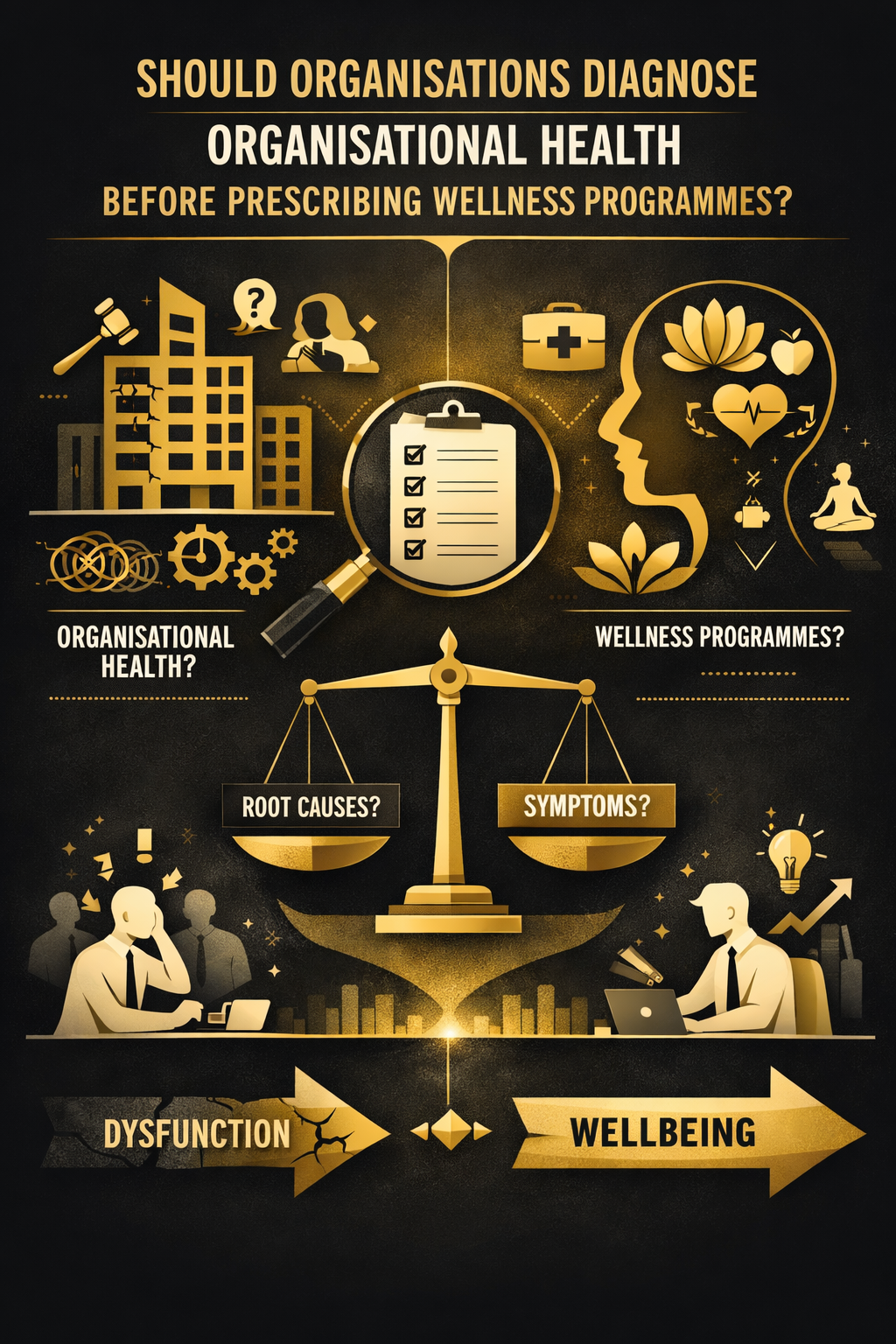
Organisations may need to begin by diagnosing organisational health before prescribing wellness interventions.
- This includes assessing:
- Leadership practices and organisational culture
- Governance and accountability systems
- Workload distribution and role clarity
- Communication and decision-making processes
- Psychosocial risks embedded in organisational systems
Such a diagnostic approach helps identify root causes of employee distress and ensures that wellness programmes address both individual and systemic factors.
Concluding Reflection
Organisational wellness and organisational health are interdependent. Wellness initiatives support employees, while organisational health ensures that leadership, systems, and culture create conditions in which employees can thrive.
Diagnosing organisational health before prescribing wellness programmes enables institutions to move beyond symptom management toward sustainable organisational effectiveness.
References
- Cooper, C. L., & Cartwright, S. (1994). Healthy mind; healthy organization—A proactive approach to occupational stress. Human Relations, 47(4), 455–471.
- Danna, K., & Griffin, R. W. (1999). Health and well-being in the workplace: A review and synthesis of the literature. Journal of Management, 25(3), 357–384.
- Lencioni, P. M. (2012). The Advantage: Why Organizational Health Trumps Everything Else in Business. Jossey-Bass.
- World Health Organization. (2010). Healthy workplaces: A model for action: For employers, workers, policymakers and practitioners. WHO Press.